
This year’s European Geosciences Union (EGU) General Assembly took place on 3-8 May 2026, in Vienna, Austria and online. There was strong representation from ASPECT researchers at the event, joining over 20,000 in-person attendees at Europe’s largest and most prominent geosciences conference. Within this there was a significant climate division with over 2,700 climate science abstracts accepted.
The conference was an opportunity for ASPECT researchers to share and discuss their work with attendees from across Europe, increasing project visibility, strengthening research networks, and fostering new connections across disciplines and institutions.
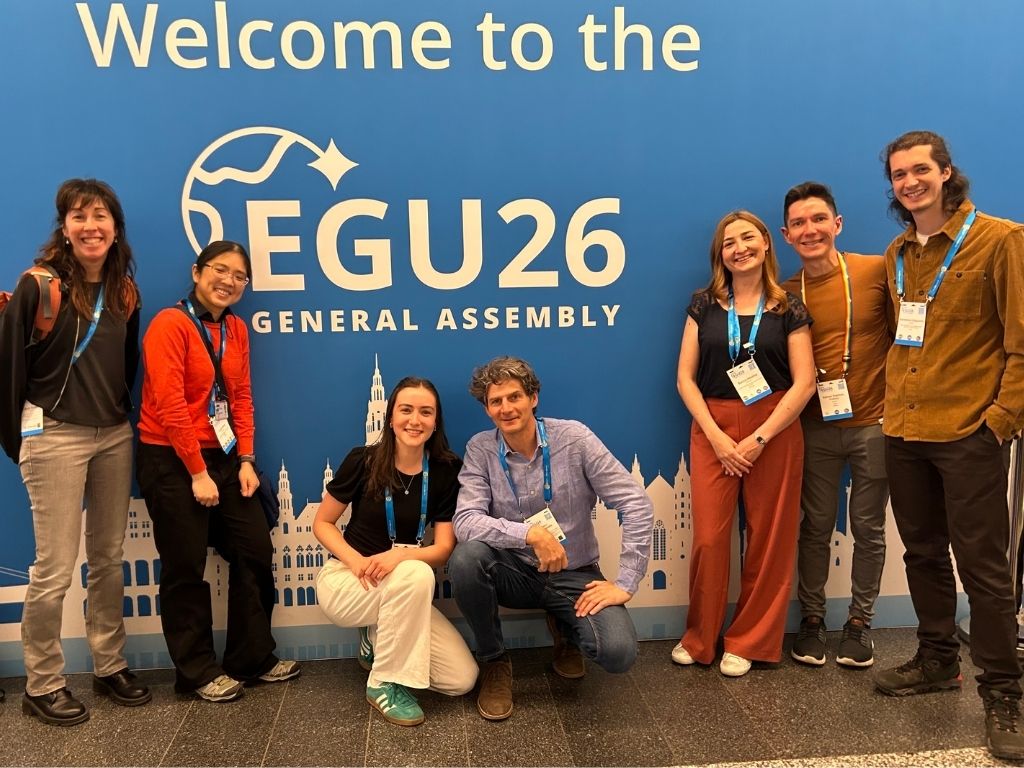
ASPECT researchers at EGU26
ASPECT researchers presented work spanning a range of topics relevant to the project’s focus. Key contributions included:
- A poster by Domenico Giaquinto on ‘Understanding AMOC changes resulting from varying historical radiative forcings’
- A poster by Yi-Chi Wang detailing ASPECT’s advancement in modelling extreme events for our Governance Super User in Emilia-Romagna
- A poster about co-developing climate information for our wine sector Super User, led by Veronica Torralba and presented by Marta Terrado
- An oral presentation by Ramon Fuentes-Franco titled ‘Dynamical Controls on Pacific-Origin Rossby Wave Propagation Across the North Atlantic-European Sector’
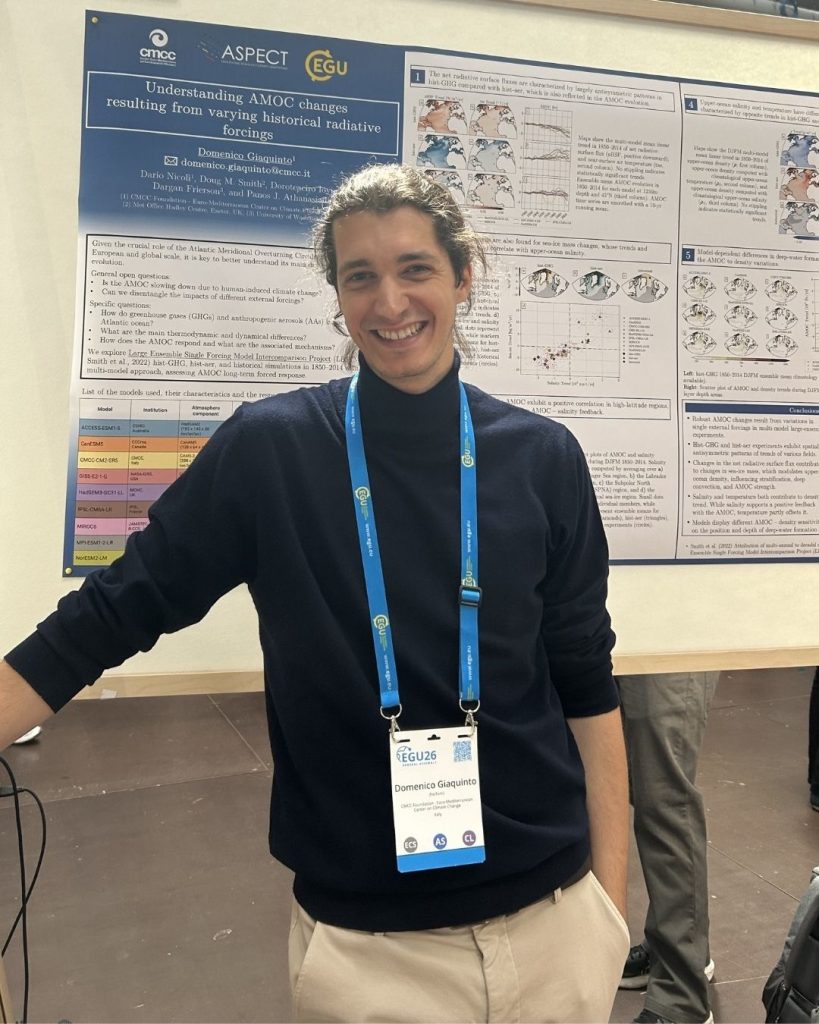
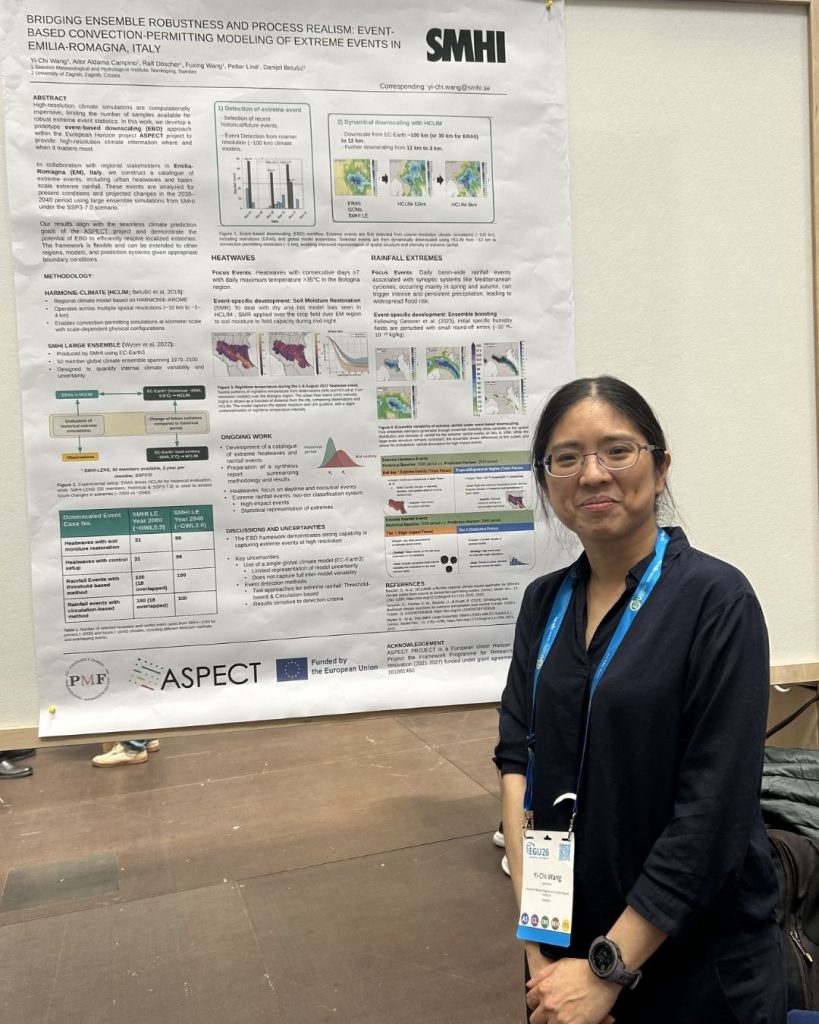
Fig.1 Domenico Giaquinto with his poster on ‘Understanding AMOC changes resulting from varying historical radiative forcings’. Fig.2 Yi-Chi Wang with her poster detailing ASPECT’s advancement in modelling extreme events for our Governance Super User.
Together, these contributions demonstrate the breadth of ASPECT research, from large-scale climate dynamics to user-focused applications supporting decision-making.
ASPECT researcher Bianca Mezzina convened the session ‘Climate predictions from seasonal to multi-decadal timescales and their applications’, bringing together researchers working at the forefront of climate predictability.
With around 30 abstracts accepted, the session provided a platform to explore both advances and limitations in predicting climate variability across seasonal to decadal timescales, as well as their practical applications.
As part of this session, ASPECT scientist Panos Athanasiadis presented research on the North Atlantic Oscillation, titled ‘The NAO decadal predictability determined by initial ocean heat content anomalies in the subpolar North Atlantic – SST gradients playing a key role’.
Participation in EGU26 helps to raise the visibility of ASPECT within the wider geoscience community, reinforcing connections between project partners and the broader research landscape.
By engaging with scientists across Europe and beyond, ASPECT researchers are contributing to ongoing efforts to improve understanding of climate predictability and to enhance the usability of climate information for real-world decision-making.