
2nd Webinar for the governance sector
As part of the ASPECT webinar series, the second webinar dedicated to the governance sector will take place on Monday 15 June 2026, from 15:00 to 16:00 CEST.
Climate change is increasingly affecting regions and communities across Europe, creating growing challenges for governance and decision-making. As extreme events such as heatwaves, heavy rainfall and droughts become more frequent, local and regional authorities need reliable climate information to support planning, adaptation and resilience-building.
To address this need, the European project ASPECT has worked with stakeholders in the governance sector to explore how climate predictions can support decision-making processes. Focusing on the Emilia-Romagna region as a case study, the project adopted a co-production approach to identify user needs and develop climate indicators related to extreme rainfall and heatwaves.
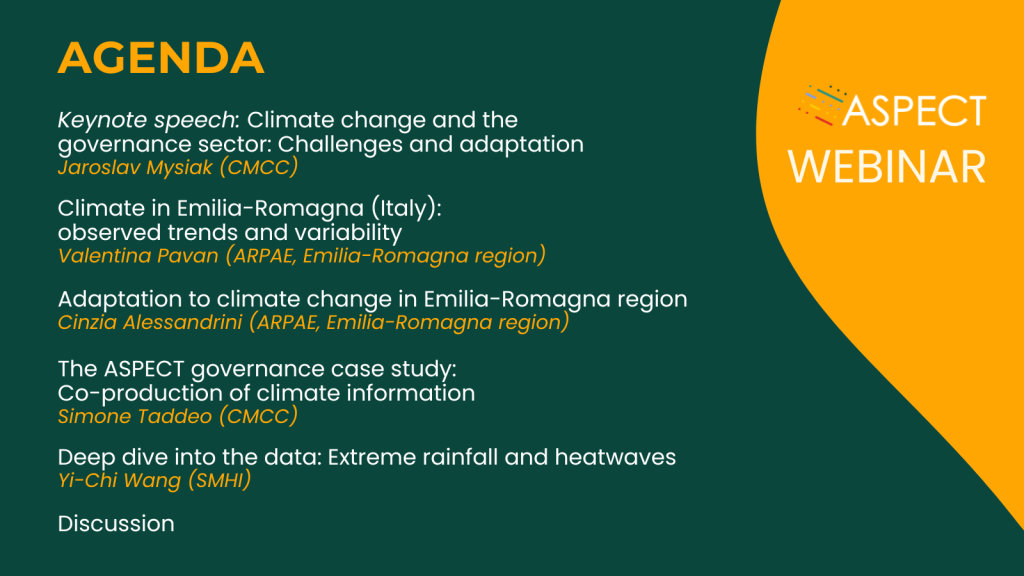
The webinar will explore how climate predictions can support adaptation planning, present the work carried out in the Emilia-Romagna case study, and discuss how this type of climate information could be applied in other regional contexts.
Registration is now open.
The agenda for this webinar can be found below: